I reviewed Rachael and Sammy's blogs. I picked Rachael's blog for this unit because she talked about completely different things than I did. Rachael informed me that there are four styles of wall paintings, which I had not known previous to reading her blog. She also mentioned how Pompeii had a very common style for their Forum that many cities now have today. The picture she used really shows how similar current day forums look compared to back then. Sammy took a different approach and talked about the arrangement of houses and how they were more suited for privacy and space. The furniture examples she used seem to be very similar to modern times. This shows how much influence we took for Italy.
You can view their blogs here:
Rachael: http://www.history1rap.blogspot.com/
Sammy: http://www.history1sjn.blogspot.com/
Tuesday, February 11, 2014

Pompeii
Pompeii was a city in Italy near the town of Naples. Pompeii was one of the many areas that was destroyed by the eruption of Mt. Vesuvius in 79 A.D. Most of the town was covered in about 13- 20 feet of ash. On the eve of that fateful eruption, scholars estimate that there were about 20,000 people living in Pompeii and the surrounding region. I cant imagine losing everything I had, especially during that time period. It would definitely take years to rebuild with limited resources. This picture of the volcano erupting is breathtaking and scary all at the same time.

Pompeii was rediscovered in the year 1599 when an underground channel was found. While doing research on Pompeii, I noticed how I saw a lot of ruins were uncovered along with inscriptions and murals painted on these cave walls. It amazes me how we can find out so much about the past by uncovering hidden artifacts from back then. It makes me think of objects that would be left behind now that would inform future researches about our life now.

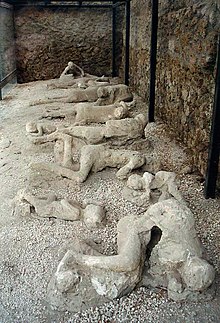
Above shows the "Garden of the Fugitives" that shows plaster casts of victims still in situ; many of these casts are in the Archaeological Museum of Naples.
 Current Applications of the Pompeii life style


Pompeii was rediscovered in the year 1599 when an underground channel was found. While doing research on Pompeii, I noticed how I saw a lot of ruins were uncovered along with inscriptions and murals painted on these cave walls. It amazes me how we can find out so much about the past by uncovering hidden artifacts from back then. It makes me think of objects that would be left behind now that would inform future researches about our life now.

Above shows the "Garden of the Fugitives" that shows plaster casts of victims still in situ; many of these casts are in the Archaeological Museum of Naples.
Current Applications of the Pompeii life style
Pompeii Movie
There is a movie about Pompeii coming out on February 21, 2014. Here is a sneak peak at the trailer and other information about the movie and cast.
Byzantine Empire Discussion
I looked at Emily P's blog as well as Samantha's blog. Emily taught me that out of 150 churches in Athens, 24 have survived virtually intact and that 85 have been destroyed. It's amazing to hear that so many churches have survived even though 24 sound like such a small number. With the amount of resources they had back then, I would have thought less than that would have lasted. I really enjoyed her pictures of the modern Byzantine interiors. They were very colorful and detailed. Samantha talked about how she likes the Byzantine style because she enjoys geometric shapes and tiled walls. I like that she tied in her own person style with the Byzantine look. She really showed this by giving modern applications that have lots of geometric, tiled walls.
You can view their blogs here:
Emily P: http://www.history1evp.blogspot.com/
Samantha: http://www.history1skf.blogspot.com/
You can view their blogs here:
Emily P: http://www.history1evp.blogspot.com/
Samantha: http://www.history1skf.blogspot.com/
Sunday, February 9, 2014
Byzantine Empire
The Byzantine Empire was the longest period in European history and is now referred to as Istanbul. The Empire was influenced by the Orient and the Greeks. They took the look of the dome from the east and the square base of the classical temple from the west to create Pendentive construction. The Pendentive method is described as the method of supporting a circular dome on a square base. One example of the Pendentive method is the Hagia Sophia, which means 'church of the holy wisdom'. This church collapsed 2-3 times during construction.
 The Hagia Sophia view of the exterior. This shows the dome on the top as well as how the four corner towers outline the square base that is part of the Pendentive method.
Below shows how the Pententive shape takes form to create the Hagia Sophia.


Below shows how the Pententive shape takes form to create the Hagia Sophia.
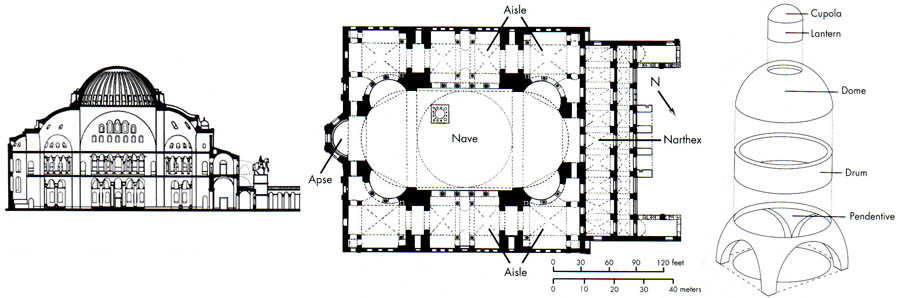
Byzantine architecture and interior design consisted of arches, domes, mosaics that had gold or lapis backgrounds, central planning, alternating stone colors or stone and brick, vaults, interiors divided into bays, and using marble to tile floors because it was most durable.
Here are some current applications of Byzantine style to help understand their style.
 k
k
Wednesday, February 5, 2014
Early Christian Discussion
Melanie's blog grabbed my attention because she somewhat tells a story with her blog rather than just listing facts about this time period. She mentioned how the Christians used concepts that the Romans used but modified them to focus on the one God. The picture that Melanie used to show the difference in Basilica's really helped me understand the Christians concept better. Just by adding the transcepts on both sides of the Basilica, it becomes a whole new shape. She also talked about the mosaic motifs, which I had not in my blog, so it was nice to read about something different. Megan D's blog also talked about the style of the churches and how they used the style of the Dome which was inspired from the Roman mausoleums. I like her examples of the churches by showing a drawing of the monument as well as showing the design of the outside.
You can view their blogs here:
Melanie: http://www.history1mlh.blogspot.com/
Megan D: http://www.history1mmd.blogspot.com/
You can view their blogs here:
Melanie: http://www.history1mlh.blogspot.com/
Megan D: http://www.history1mmd.blogspot.com/
Tuesday, February 4, 2014
Early Christian Civilization
The Christian Civilization was the beginning of the Middle Ages occurring from 330- 800 C.E.
Christianity began with the death
of Christ in ancient Judea, an eastern outpost of the Roman empire. Christianity promoted access to
God through Jesus Christ in a personal relationship which provided great hope, most of the time, those in the lower classes. Constantine declared Christianity an official religion in 313 C.E. Constantine believed he had received a sign from God before the battle of Milvian Bridge. This sign was a vision of a shield containing a Christian cross.


Christian Architecture main goal was to glorify God. They had separate baptisteries, centrally planned buildings, clerestory windows, and the entrance of the church was opposite of the apse. An example of Early Christian Civilization architecture is the Old St. Peter's Cathedral of Rome. The total length of this cathedral is 700ft.
Most Christian furniture was made for storage and was very elaborate as well as richly decorated with jewels and carvings. Here are a few modern applications of Christian furniture with some old flare.
Classical Rome Discussion
I chose Natalie's blog and Yo's blog for my discussion about Rome. Natalie's blog interested me because she incorporated pictures of her own experience when she studied abroad in Italy. Having close up pictures of both the Colosseum and the Pantheon show a more accurate display of how big they really look. I would love to travel to Italy one day to see for myself how incredible the architecture really is. I also like the fact that Natalie used modern applications that aren't exact replicas of the past, but use inspiration from that time. I enjoyed Yo's blog for this topic because he went into more depth about how Roman architecture relates to Greece architecture. He talked about how some current designers believe that columns are a "designer's nightmare", but I feel that incorporating columns into a design creates interest and length.
You can view their blogs here:
Natalie: http://www.history1nml.blogspot.com/
Yo: http://www.history1ys.blogspot.com/
You can view their blogs here:
Natalie: http://www.history1nml.blogspot.com/
Yo: http://www.history1ys.blogspot.com/
Subscribe to:
Posts (Atom)